Are Your Social Media Accounts Secure?

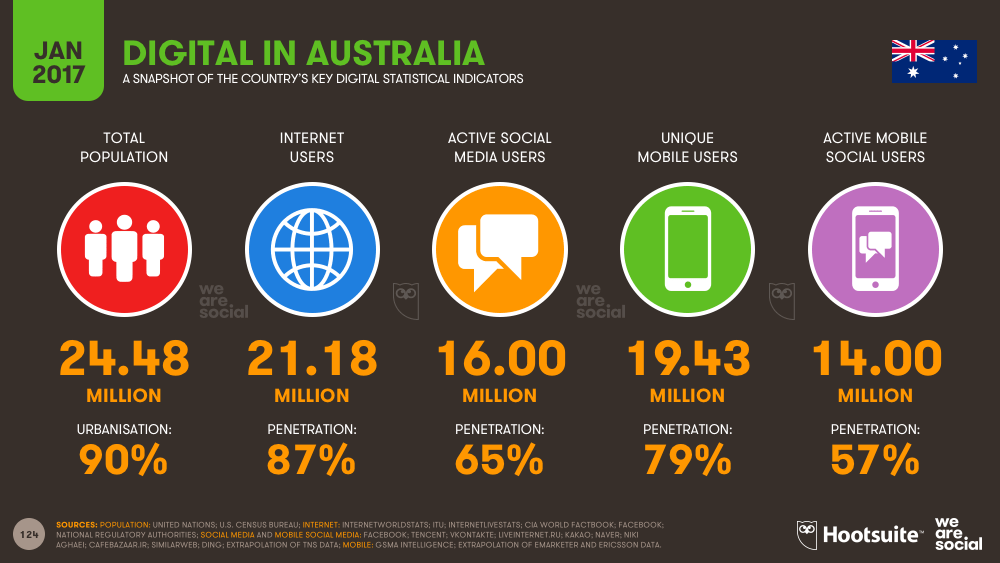
Social media users are firmly an integral part of Australia’s society, with approximately 18 million active users, an increase in 4 million users since 2017 depicted in the graph below.
There is no doubt that social media is at the forefront of marketing, not to mention everyday life. Considering how much information and trust people place into these social media platforms, it begs the question, are our accounts secure? And if not, how do we secure them?

For example, Facebook for one has been known to experience breaches in mass numbers. Back in 2018, 50 million account users experienced various bugs, enabling the attackers access to the victim’s profile and private information.

Here are two tips to safety tips to maximise the security on your socials.

  1. Two-factor authentication

=Two-factor authentication is in essence, a dual factor authentication process. Here, users’ access depends on methods providing a password as well as a second factor, usually either a security token or a biometric factor like a fingerprint or facial scan.

Two-factor authentication adds an additional layer of security to the authentication process by making it harder for attackers to gain access to a person’s devices or online accounts, because knowing the victim’s password alone is not enough to pass the authentication check.

2. Stay away from phishing attacks and scams

Phishing scams use social media to trick people into handing over personal information, including banking details, passwords, or business information.

A recent social media scam involved false reports that the actor Rowan Atkinson had died.

What looked like a video link actually directed users to a page that said their computer had been locked, with a phone number to call for support. The phone line connected to scammers looking for credit card numbers and personal information. Worse, the support software offered was a virus.

AI in Retail Marketing

Retailers are working in a very competitive market, trends are always changing and resurfacing. More so, consumers are faced with an overwhelming array of choice while shopping. This presents a danger to businesses.

When consumers are faced with so many options, most consumers fall victim to ‘choice paralysis’, which describes the moment when we are faced with more possibilities than we can comprehend. This usually results in low purchase decision confidence and frustration.

Retailers can now receive marketing help from an AI assistants that are always working in the background. These virtual assistants can automate your processes, create workflows, and even recommend marketing and business decisions.

What is AI and What are Virtual Assistants?

A virtual assistant is software which helps people find relevant information, interpret data, and carry out tasks. These assistants are starting to permeate various industries, including the retail industry. You can find them in businesses doing things qualifying sales leads. A virtual assistant could give advice on how to market your products. It could also make suggestions on when to send an email or what type of discount to offer.

To put together a marketing strategy yourself may take hours upon hours. AI can save time by giving retailers actionable advice, and they save money by being more affordable than a consultant/marketer.

What AI and Virtual Assistants can do/improve:

  1. Connect to large data sets.
  2. Product suggestions based on what customers are likely to buy next and what customers have bought or viewed previously.
  3. Suggesting loyalty rewards that your store can use to boost customer loyalty and increase revenue.
  4. Automatically emailing a reminder to anyone who abandons items in their online cart – and timing these emails based on what has worked for other retailers.

Building New Chatbots

Whether we like it or not, chatbots are here to stay. Chatbots have become increasingly popular, largely due to dramatic advancements in our machine learning technology. The chatbots of today are smarter, more responsive, and more useful. We’re likely to see even more of them in the coming years.

Chatbots can prove to be a great digital marketing advantage, mostly due to the amount of customer feedback and data it collects. Chatbots, known also as conversational agents, are software applications that mimic written or spoken human speech for the purposes of simulating a conversation or interaction with a real person.

For example, clubs in a short-format cricket competition, such as the Big Bash League find it very difficult to build an audience and establishing a brand among so much competing noise. The Sydney Sixer’s Manager has introduced a new chatbot to engage with its users.

“For us it is about how we can share information, so people don’t have to go into an app to get that,” Hawkins says. “The Big Bash is all about fan-first, so we are all about creating and using innovation that allows our fans to get closer to the club.”

There are two primary variations of chatbots that can be offered to users;

  1. Chatbots through standalone apps.
  2. Web-based applications.

I recommend using web-based applications for the reason that it appeals to convenience. For example, installing a chatbot on Facebook messenger or on a business website is introducing the chatbot on a medium where the customer is already present, rather than having to download an app.

The Do’s and Don’ts of SEO

SEO is a marketing discipline focused on growing visibility in organic search engine results. It is not just about improving your rank on search engines. Its primarily about making your site better for your users

The DO’s

  1. Write engaging content

Your blogs/articles/journals have to be well-researched and need to engage with the readers. Google will track how long people will stay on your page. The longer they do, the better! This is a great way to avoid high bounce rates.

2. Use keywords

It’s important to know which keywords are most popular in your industry searches. Make sure to do a keyword search with Google Keyword Tool. This shows you what phrases and key words people are using in their searches.

3. Get back links from other sites

Blacklinks from websites increases both your credibility online and your SEO. In short, this is when other websites, preferably in your industry, mention and link your website on theirs.

The Don’ts

  1. Don’t use hidden texts

Hidden text is one of the oldest tricks in the SEO book. If you’re hoping hidden text will somehow boost your SEO efforts, you’ll quickly discover this outdated tactic is ineffective. Google can detect hidden texts and will penalise your website.

2. Avoid irrelevant links

Links from non-related sites will most likely lead to penalisation. More so, it makes no sense to have links from other industries on your website.

3. Don’t wait too long to implement SEO

When you are launching a new website, SEO should be a heavy consideration from the beginning. It is a much smoother process than trying to revitalise a page and increase its optimisation.

https://www.searchenginejournal.com/hidden-text-seo/208866/#close

SEO “Don’ts”: 20 Fatal Mistakes You Must Avoid To Succeed

Data Analytics

Don’t Be Confused

Data analyst is not to be confused with a data engineer or data scientist. Those types of roles largely involve data mining or data storage. Data analysts pull relevant bits of information from enormous databases in order to inform decisions in a number of business areas like HR, marketing, customer service and operations .

The New Frontier

From large scale businesses to small niche cafes, positive results are achieves by studying trends. It is an invaluable skill to be able to interpret data and form strategies for the future of your company/business. Imagine being at the centre of all that. Imagine being the person they turn to before they make any major business decision.

Data Analytics is Everywhere

Just as it has become imperative to use computers in today’s workplace, the use data analytics professionals to foster growth is slowly catching on. There is practically no sector which has remained untouched from the reach of Data Analytics.

Source: https://www.teradata.com.au/Blogs/5-Big-Benefits-of-Data-and-Analytics-for-Positive-Business-Outcomes

Personal Relevance

Through the ability to analyse and put data and information to good use, you will be able to identify new and potentially unexploited streams of revenue generation. You will be able to make calculated decisions, increasing your earnings through multiple streams of revenue and enriching your life. Some universities in Melbourne offer great postgraduate and undergraduate courses in data analytics.

The Digital Customer Journey

The digital customer journey is a complete framework of the different digital stages from awareness, to consideration, to purchase. It allows a organisations to see how customers, clients and prospects interact with their services/product or the business itself.

Why it’s Important

I think digital customer journeys are particularly important for the long term relationship between organisation and consumer. Its central focus is no about transactions or digital conversions. Digital marketing has evolved into personable/relationship marketing. Keeping a record and managing all customer touch-points is important in the customer approach for a business.

A 5-step process to analyse a client’s digital touchpoint:

  1. Identify and evaluate each touchpoint interaction
  2. Determine if there is room for improvement and establish best practices
  3. Implement the suggested improvements
  4. Measure the impact of those improvements
  5. Declare success or go to Plan B for improvement

Source: https://www.uprightcommunications.com/blog/digital-touchpoints-what-are-they/

Challenges

A major challenge I can recognise in the digital customer journey is privacy.

Ethically, it may not be considered appropriate for brands to use the data they store. Businesses are know to collect and largely purchase mass amounts of data on the consumers they have targeted.

In this digital age nothing is safe. People may be unaware of the data they are providing to businesses. Furthermore, digital users may not be constantly aware that the business are listening. e.g. Facebook Messenger.

It is entirely possible that Facebook is tracking our conversations and collecting what points of conversations are trending.

Do businesses have a moral responsibility to outline which point is an invasion of privacy?

Create your own website, free on WordPress.com.Create your own website.
Start free